
Skip to main content
Engineered plastic bearing solutions
Match the Material
to the Motion.
From economical Nylon 101 to PTFE-based and composite bearing families, Bunting offers plastic bearing options for applications where weight, corrosion, lubrication, temperature and mating-surface requirements drive material selection.
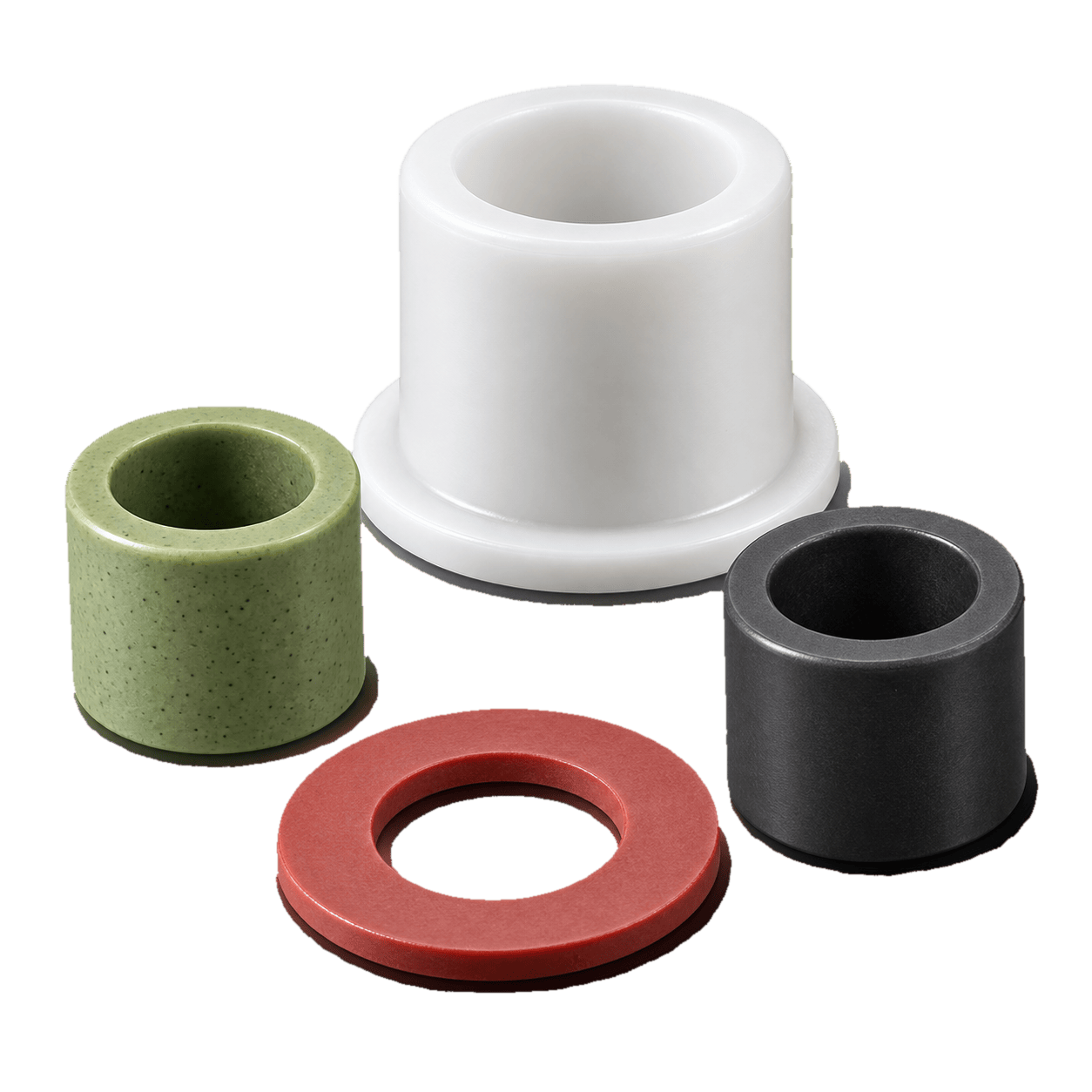
Select around the application
Plastic bearing performance starts with the operating conditions.
No single plastic grade is best for every bearing. Load, speed, temperature, shaft material, environment and allowable wear must be evaluated together.
Load & Speed
Use projected bearing pressure and surface velocity to compare the application against the material’s published PV limits.
Temperature
Consider steady-state temperature, startup conditions and heat generated at the sliding interface—not ambient temperature alone.
Environment
Review chemical exposure, moisture, contamination, vacuum requirements and whether external lubrication is acceptable.
Mating Surface
Shaft hardness, finish and material affect friction and wear. Some grades are specifically suited to softer mating surfaces.
Material families
Options spanning economical standard bearings through demanding dry-running service.
Nylon 101 Bearings
An economical choice where the performance and strength of a metal bearing are not required. Bunting lists sizes for shafts up to 1 inch.
- Temperature
- -20°F to +250°F
- Maximum PV
- 3,000
- Available forms
- Sleeve, flange, thrust
PTFE BJ Series
BJ2, BJ4, BJ5 and BJ7 address different combinations of rigidity, toughness, chemical resistance, dry-running performance and mating-surface compatibility.
- Temperature
- -250°F to +550°F
- Maximum PV
- Up to 40,000; varies by grade
- Available forms
- Sleeve, flange, thrust, bar
BPT Composite Sleeves
Nonmetallic, self-lubricating composite sleeves intended for oscillatory and linear applications where long wear and a shaft-friendly bearing surface are important.
- Temperature
- -212°F to +356°F
- Maximum PV
- 20,000
- Available forms
- Sleeve bearings
BNW Composite Sleeves
Self-lubricating composite sleeves with a PTFE and synthetic-fiber bearing layer over a fiberglass-reinforced epoxy backing.
- Temperature
- -212°F to +350°F
- Maximum PV
- 30,000
- Available forms
- Sleeve bearings
Vespel Bearings
Precision-machined polyimide bearings for demanding applications involving elevated temperature, speed, load, wear or creep resistance.
- Temperature
- -400°F to +550°F; +900°F intermittent
- Maximum PV
- 300,000
- Available forms
- Sleeve, flange, thrust
BU Bearings
Wrapped composite bearings with a steel backing, porous bronze interlayer and PTFE bearing surface for dry-running applications.
- Temperature
- -328°F to +536°F
- Maximum PV
- 51,000
- Available forms
- Inch/metric sleeves, washers, strip
A better starting point
Use PV to screen the bearing application.
PV combines projected bearing pressure with sliding-surface velocity. It is a useful first check, but final selection also depends on temperature, duty cycle, lubrication, shaft finish, clearance and environmental exposure.
Load divided by projected bearing area
Sliding surface velocity in feet per minute
Published limits are material-specific. Do not apply one grade’s rating to another grade.
Specify with the full system in mind
Bring the application data—not just the bearing size.
- Shaft diameter, housing size and available length
- Radial or thrust load and duty cycle
- RPM or linear speed
- Operating and peak temperature
- Shaft material, hardness and finish
- Chemical, moisture and contamination exposure
Need help narrowing the material?
Start with load, speed, temperature and environment.
Share the operating conditions and target dimensions so the available plastic bearing families can be compared against the application.