
Skip to main content
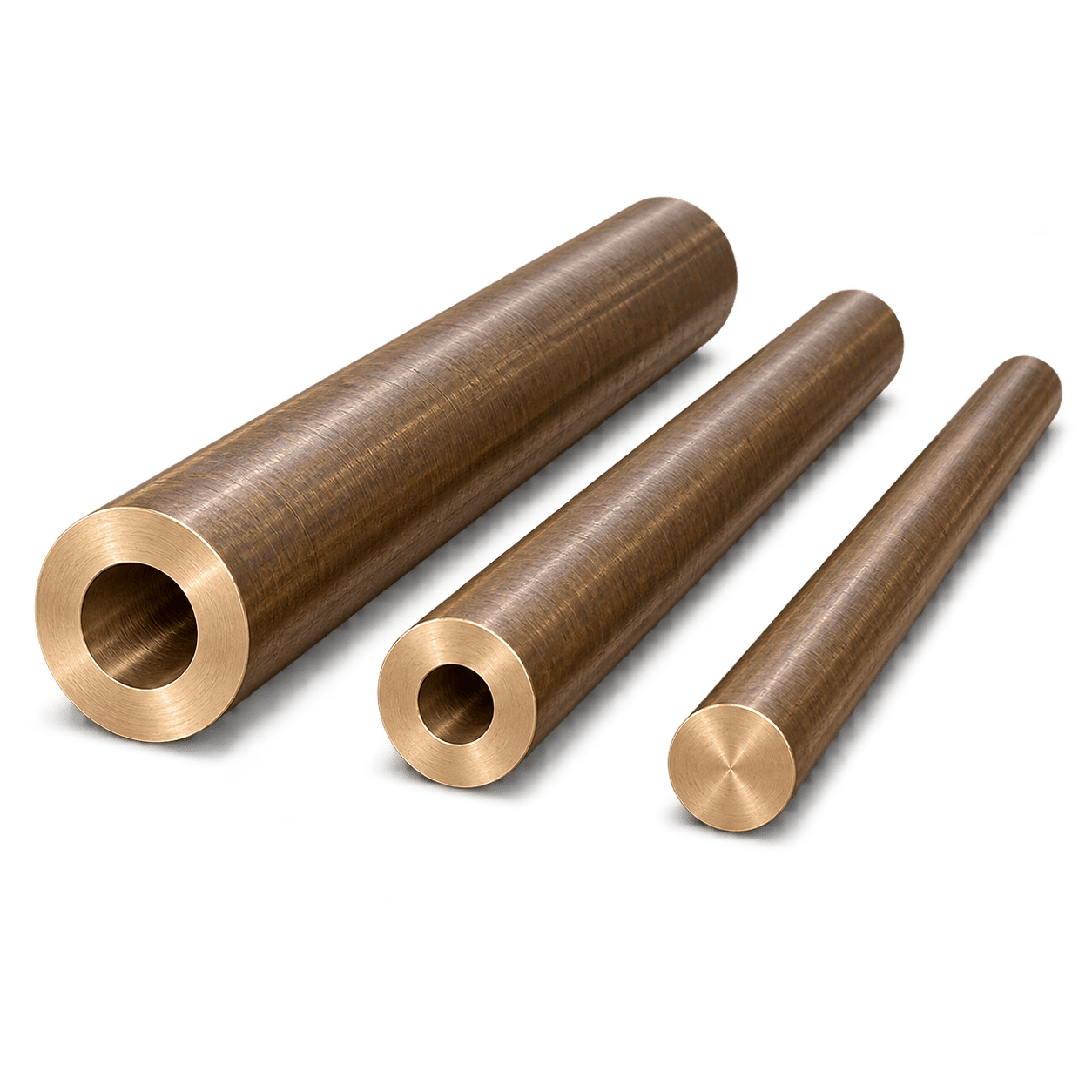
Why continuous-cast stock
Consistent material for repeatable machining.
Continuous casting solidifies bronze through a controlled die and
withdrawal process. The resulting stock is selected for a dense,
consistent structure that supports predictable machining and
finished-component quality.
-
Solid, cored and flat forms help control machining time and
material removal -
Published alloy chemistry and mechanical-property data support
material selection -
Standard and nonstandard lengths and sizes can be evaluated for
the job -
Cut length, machining allowance and certification needs can be
defined at quotation
Common alloy families
Compare strength, machinability and available stock forms.
Use the published values as a screening tool, then confirm the
exact form, condition, dimensions and governing specification
before release.
C93200 / SAE 660
General-purpose bearing, bushing and washer alloy with broad
availability and good machinability.
- Min. tensile
- 35,000 psi
- Min. yield
- 20,000 psi
- Machinability
- 70
- Stocked forms
- Solid, cored, wearplate
C89835
Copper-bismuth alloy commonly considered where a non-leaded
alternative to C93200 is needed.
- Min. tensile
- 30,000 psi
- Min. yield
- 14,000 psi
- Machinability
- 70
- Stocked forms
- Solid and cored
C90300 / SAE 620
Tin bronze for bearings and components where strength, corrosion
resistance and wear performance matter.
- Min. tensile
- 44,000 psi
- Min. yield
- 22,000 psi
- Machinability
- 30
- Stocked forms
- Solid
C86300 / SAE 430B
High-strength bronze considered for heavily loaded equipment,
roll-neck and machine-tool bearing applications.
- Min. tensile
- 110,000 psi
- Min. yield
- 62,000 psi
- Machinability
- 80
- Stocked forms
- Solid and cored
C95400
Hard, strong and abrasion-resistant alloy for low-speed,
high-load service with proper shaft and lubrication design.
- Min. tensile
- 85,000 psi as cast
- Min. yield
- 32,000 psi as cast
- Machinability
- 60
- Stocked forms
- Solid, cored, wearplate
C95500
High-strength aluminum bronze family for demanding load, wear
and elevated-temperature requirements.
- Min. tensile
- 95,000 psi as cast
- Min. yield
- 42,000 psi as cast
- Machinability
- 50
- Stocked forms
- Solid and cored
Mechanical values shown are Bunting catalog minimums for the stated
continuous-cast condition where published. Heat treatment, form and
specification can change requirements. Catalog properties are not a
substitute for the released material specification.
Build a complete request
Quote the finished part—not only the raw-bar diameter.
The strongest starting point is a print or a complete dimensional
and operating description. That lets stock form, machining
allowance and alloy be reviewed together.
- Finished outside and inside diameters
- Finished length and quantity
- Requested alloy and ASTM requirement
- Acceptable machining allowance
- Load, speed and lubrication method
- Shaft hardness and surface finish
- Temperature and environmental exposure
- Cut length and certification needs